
Resilience & Courage

Recent Content

The Only Life You Have

The Only Life You Have

Post

Kazuo Ishiguro writes about the lives we did not choose. Discover why accepting the life you are actually living is its own form of quiet courage.

Habit Over Inspiration

Habit Over Inspiration

Post

Octavia Butler knew inspiration is unreliable. Discover why the writers and creators who last are the ones who show up by habit, not by feeling.

The Hardest Thing to See

The Hardest Thing to See

Post

George Orwell believed clarity is an act of courage. Discover how seeing things plainly -- and saying so -- transforms both your thinking and your life.

Show, Don't Announce

Show, Don't Announce

Post

Anton Chekhov believed the most powerful writing never announces itself. Discover how showing instead of telling transforms the way you communicate and connect.

Beauty as the Last Rebellion

Beauty as the Last Rebellion

Post

Fyodor Dostoevsky believed beauty holds a redemptive power most of us overlook. Discover what he meant and how it applies to the way you move through the world.

See All Content
Terms and ConditionsDo Not Sell or Share My Personal InformationPrivacy PolicyPrivacy NoticeAccessibility NoticeUnsubscribe
Copyright © 2026 Inspirational Quotes

Reframing Failure

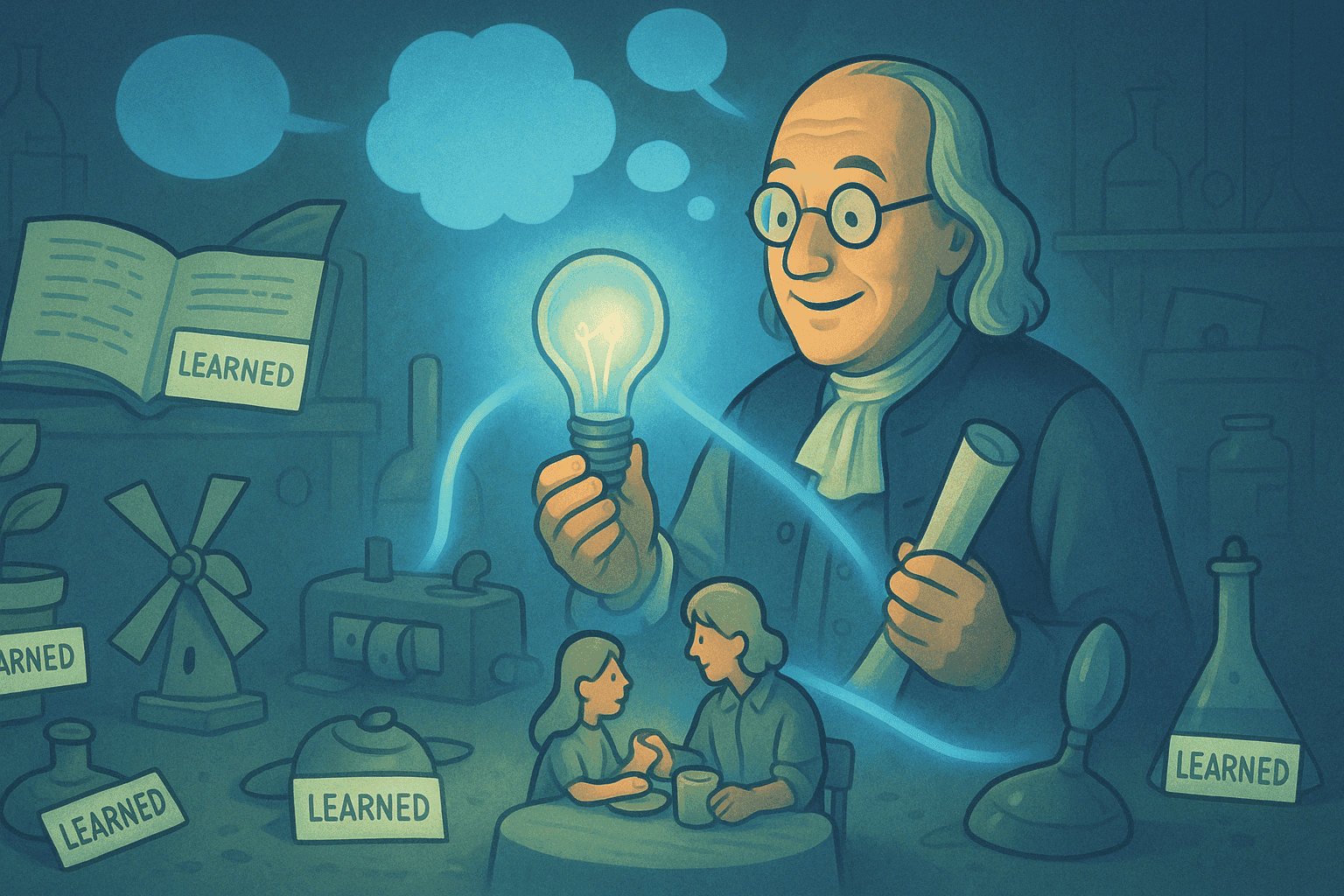
Benjamin Franklin surrounded by inventions

"I didn't fail the test. I just found 100 ways to do it wrong."

— Benjamin Franklin

Benjamin Franklin (1706-1790) was a Founding Father of the United States and one of history's most accomplished polymaths. Starting as a printer's apprentice with minimal formal education, Franklin became a successful author, scientist, inventor, diplomat, and statesman. His scientific experiments, particularly with electricity, demonstrated his willingness to test hypotheses through trial and error. Franklin's numerous inventions—including bifocals, the lightning rod, and the Franklin stove—often evolved through multiple iterations and "failures." Throughout his long career of innovation, Franklin maintained a mindset that reframed unsuccessful attempts not as defeats but as elimination of possible approaches, paving the way toward eventual success.

Resilience and Courage
Personal Growth
Creativity and Purpose

Context

This quote captures Franklin's empirical approach to discovery and innovation. As a self-taught scientist conducting numerous experiments, particularly with electricity, Franklin understood that unsuccessful trials provided valuable information rather than representing personal inadequacy. His statement demonstrates cognitive reframing—transforming "failure" from a negative judgment into useful data collection. This perspective shift reveals the experimental mindset that enabled Franklin's prolific innovations, from bifocals to lightning rods. The quote's humor ("100 ways to do it wrong") further shows how lightness and resilience toward setbacks facilitate sustained effort. Franklin's approach echoes modern innovation methodology, which recognizes that breakthrough solutions often emerge only after systematically eliminating multiple unworkable approaches. His insight remains relevant for anyone pursuing difficult goals requiring persistence through inevitable disappointments.

Today's Mantra

I view each "failure" as valuable data collection, moving me closer to success with every attempt.

Reflection Question

What recent "failure" have you experienced that could be reframed as valuable data collection that eliminates one approach and points toward potentially more successful alternatives?

Application Tip

Create a "Learning Inventory" by selecting a significant challenge you're currently facing. When you encounter an unsuccessful attempt, immediately document it using Franklin's framework: "I found one way this doesn't work because..." followed by the specific observation. Next, add "This suggests I should try..." with your next approach based on this new information. Maintain this inventory visibly, treating each entry as a badge of progress rather than a record of failure. After accumulating ten entries, review the pattern to identify any systematic adjustments needed in your overall approach. This practice builds the scientific mindset that transformed Franklin from a printer's apprentice into one of history's great innovators.